Lukas
sponsored). If you click through and subscribe, we may earn a recurring commission at no extra cost to you. This supports our independent benchmarks and testing lab.
I have watched smart founders burn through over $150,000 because an enterprise VP of Sales joined their Series A startup and insisted: “We need Salesforce on day one, or we can’t scale.”
Nine months later, the scenario is almost always the same. Half the sales team refuses to log calls because the UI feels like filling out tax forms in 2004. The custom fields are a tangled mess. An external consultancy is charging $220 an hour just to fix a broken lead assignment rule. And the leadership team is staring at a renewal bill that makes their eyes water.
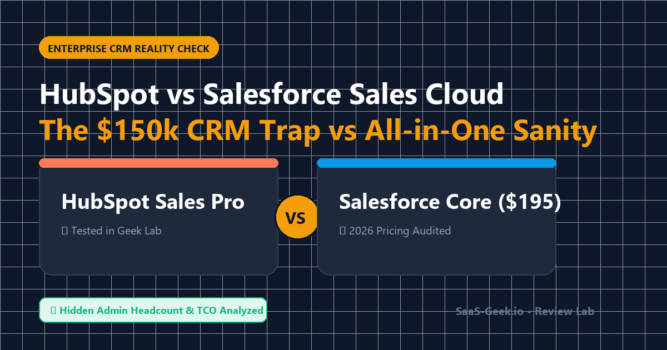
In 2026, the battle between HubSpot Sales Hub and Salesforce Sales Cloud is no longer about which tool has more checkboxes. It is about Total Cost of Ownership (TCO) versus Engineering Overhead. Let’s break down the actual reality without the corporate marketing gloss.
🏆 2026 Total Cost of Ownership Winner
HubSpot Free Tier • 14-Day Free Trials Available
Top Pick: HubSpot for 90% of Growing Teams / Salesforce for Complex Enterprise Architectures
Stop paying for Salesforce unless you have a dedicated full-time Salesforce administrator ($120k+/yr) and complex multi-currency CPQ rules. For fast-moving SMBs and mid-market revenue teams, HubSpot Sales Hub gets your reps actually logging calls in week one, integrates marketing without broken API bridges, and saves tens of thousands in hidden consultancy fees.
The 2026 Head-to-Head Reality Matrix
Salesforce recently revamped its pricing by retiring legacy Enterprise plans and rolling out Core ($195/seat/mo), Advanced ($395/seat/mo), and Max ($550/seat/mo). Here is how they stack up directly against HubSpot Sales Hub:
The Three Things Sales Reps Will Never Tell Their VP
1. UI Adoption: If It Feels Like Homework, Your Data Is Garbage
The best CRM in the world is the one your account executives and SDRs actually update. HubSpot’s interface feels like a modern SaaS app—fast, contextual, and clean. Salesforce Lightning, despite endless updates, still carries the baggage of a 25-year-old relational database. Every click involves loading spinners, nested modal popups, and validation rule errors.
2. The “Hidden Salesforce Tax” (The Admin Salary)
When you buy HubSpot Professional for 10 reps, you spend roughly $1,000/month. A competent RevOps specialist or sales manager can configure pipelines, webhooks, and sequences in a few afternoons. With Salesforce Core, 10 reps cost you $1,950/month ($23,400/yr). But that is just the software license. You will inevitably need a dedicated Salesforce Administrator ($110,000 – $140,000 salary) or an agency retainer ($3,000 – $8,000/month) just to keep the custom triggers running.
3. When Salesforce Actually Makes Sense (The Enterprise Edge)
Is Salesforce bad? Absolutely not. If you are a 500-person company with complex territory hierarchies, custom ERP integrations (SAP, Oracle), custom CPQ quoting rules, and strict SOC2 role-based data visibility permissions, HubSpot will eventually hit architectural walls. Salesforce’s Apex code, SOQL queries, and AppExchange ecosystem make it an operating system for massive corporations.
Detailed Product Breakdowns
HubSpot Sales Hub
- ✔ Reps actually use it without being threatened by sales management
- ✔ Single clean database across marketing, sales, and customer tickets
- ✔ Autonomous Breeze AI prospecting agents included in modern tiers
- ✔ No certified developer required to build multi-stage deal pipelines
- ✖ Marketing contacts get pricey quickly if your subscriber list explodes
- ✖ Mandatory $1,500 onboarding package on Professional tier
Salesforce Sales Cloud
- ✔ Unbeatable customization: if your company logic can be coded, Salesforce can run it
- ✔ Bundled Agentforce AI credits and native Tableau Next in new Core tiers
- ✔ Massive AppExchange ecosystem with 7,000+ specialized enterprise tools
- ✔ Standard for publicly traded enterprises with strict regulatory auditing
- ✖ Core plan costs a staggering $195/user/month on strict annual contracts
- ✖ Almost always requires a dedicated $120k/yr administrator or expensive consultants
- ✖ UI feels dated, heavy, and sluggish for fast-moving SDRs
SaaS-Geek Final Verdict: The 5-Second Decision Rule
Buy HubSpot if: You have fewer than 200 sales reps, want your team up and running within a week, and want marketing and sales to share the exact same clean database without syncing glitches.
Buy Salesforce if: You already employ a dedicated IT/RevOps engineering team, require bespoke Apex coding for complex billing workflows, or your executive board mandates enterprise-grade compliance that only Salesforce provides.