
 Lukas
sponsored). If you click through and subscribe, we may earn a recurring commission at no extra cost to you. This supports our independent benchmarks and testing lab.
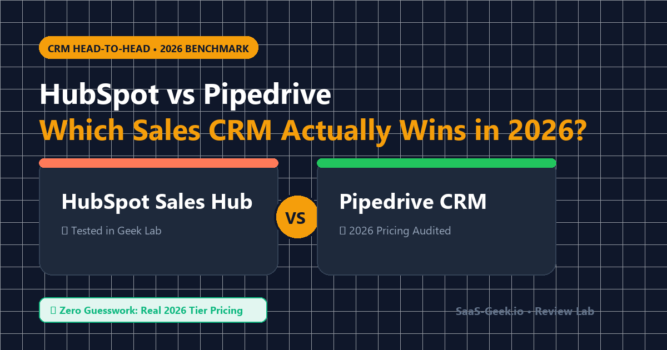
Choosing between HubSpot Sales Hub and Pipedrive in 2026 often comes down to a fundamental business decision: do you want an end-to-end inbound ecosystem that connects marketing, customer service, and sales—or do you want a laser-focused, high-velocity sales pipeline that your reps will actually enjoy using every single day?
🏆 2026 Value Winner
14-Day Free Trial (No Credit Card)
Top Pick: Pipedrive for Sales-Driven Teams / HubSpot for All-in-One Inbound
If your main objective is pure sales velocity, pipeline clarity, and predictable per-seat costs without forced onboarding fees, Pipedrive is the clear winner for SMBs. If you need marketing automation, CMS, customer service, and deep lifecycle tracking under one roof, HubSpot justifies its higher enterprise price tag.
HubSpot vs Pipedrive: Quick Feature & Pricing Breakdown
Below is our direct head-to-head matrix comparing the essential parameters, 2026 official pricing tiers, and hidden setup costs for both CRM platforms:
Head-to-Head Comparison: Key Battlegrounds
1. User Experience & Deal Tracking
Pipedrive was designed by salespeople for salespeople. The core visual kanban view is arguably the fastest and cleanest in the industry. Moving deals through stages, creating activities, and spotting stagnant leads requires virtually zero training. HubSpot is equally polished, but because it connects to contacts, companies, marketing campaigns, and service tickets, the interface can feel significantly more cluttered for a sales rep whose sole job is calling and closing.
2. Workflow Automation & AI Capabilities
HubSpot’s workflow builder is among the most powerful on the market. In 2026, HubSpot introduced Breeze AI, featuring autonomous prospecting agents that can draft outreach, research leads, and enrich company records. However, accessing custom multi-step workflows requires the Professional tier ($90+/seat/mo). In contrast, Pipedrive gives you 50 workflow automations and full email sequence sync on its Growth plan ($39/seat/mo), making automated follow-ups accessible at a fraction of the cost.
3. Total Cost of Ownership (TCO) & Hidden Fees
This is where the divergence is most dramatic. A 5-person sales team on Pipedrive Growth will spend approximately $195 / month ($39 × 5) with zero setup fees. That same 5-person team moving to HubSpot Sales Hub Professional to unlock workflow automation will pay roughly $450 – $500 / month plus a mandatory $1,500 onboarding package, resulting in a first-year difference of over $4,500.
Detailed Product Reviews
Pipedrive CRM
- ✔ Extremely intuitive drag-and-drop pipeline visualization
- ✔ Cost-effective automation starting at $39/mo (Growth plan)
- ✔ Zero mandatory onboarding fees; instant 5-minute setup
- ✔ Built-in AI sales summaries, email sequencing, and call tracking
- ✖ No permanent free plan (only 14-day trial)
- ✖ Requires third-party integrations for advanced inbound marketing

HubSpot Sales Hub
- ✔ Generous 100% free CRM tier for up to 2 users
- ✔ Seamless integration with HubSpot Marketing, CMS, and Service hubs
- ✔ Breeze AI autonomous prospecting agents and deep predictive analytics
- ✔ Massive integration marketplace (1,500+ tools)
- ✖ Steep price jump to Professional tier ($90-$100/seat/mo)
- ✖ Mandatory $1,500 (Pro) or $3,500 (Enterprise) onboarding fee
- ✖ Feature credits limit high-volume AI usage
Final Verdict: Which CRM Should You Choose in 2026?
Choose Pipedrive if: You are an SMB, agency, or B2B sales team that prioritizes outbound closing, visual pipeline deal flow, and lean software budgets. The Growth plan ($39/mo) gives you virtually everything required to scale outbound revenue.
Choose HubSpot Sales Hub if: Your company relies heavily on inbound marketing (content, SEO, lead magnets, newsletters) and already uses or plans to use HubSpot Marketing Hub. The unified contact timeline and enterprise reporting make the higher investment worthwhile.


